
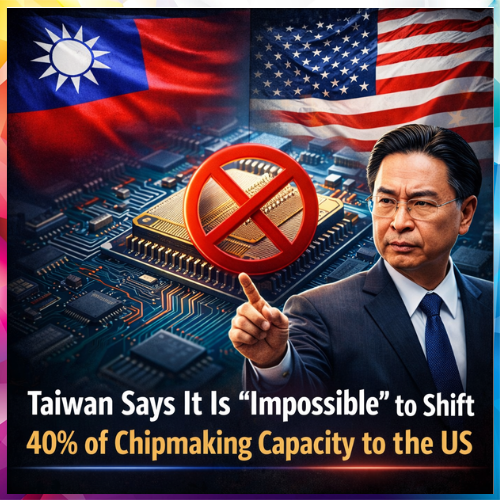
Taiwan’s vice premier and chief tariff negotiator has pushed back strongly against US calls to relocate a large share of the island’s semiconductor production, saying it would be “impossible” to move 40% of Taiwan’s chipmaking capacity to the United States.
In an interview with Taiwanese television channel CTS broadcast late Sunday, Vice Premier Cheng Li-chiun said she had made Taiwan’s position clear to Washington, stressing that the island’s semiconductor ecosystem built over decades—cannot be uprooted.
“I have made it very clear to the United States that this is impossible,” Cheng said, referring to the 40% target floated by US officials. She added that Taiwan’s semiconductor industry would continue to expand domestically, even as companies increase overseas investment.
“Our overall capacity in Taiwan will only continue to grow,” Cheng said. “But we can expand our presence in the United States. Our international expansion, including increased investment in the US, is based on the premise that we remain firmly rooted in Taiwan.”
Her comments come after remarks this week by US Commerce Secretary Howard Lutnick, who said Washington needed to bring more semiconductor manufacturing back to the US for strategic reasons.
“You can’t have all semiconductor manufacturing 80 miles from China,” Lutnick said. “That’s just illogical.” He added that the administration’s goal was for the US to secure 40% of leading-edge semiconductor manufacturing capacity by the time it leaves office.
Taiwan and the United States last month agreed to cut tariffs on Taiwanese exports to 15% from 20%, alongside commitments by Taiwan to increase investment in the US. However, Cheng said there would be no relocation of Taiwan’s science parks or core manufacturing clusters.
Instead, Taiwan is willing to share its experience in building a highly integrated semiconductor ecosystem and help the US develop a similar environment, she said. Cheng added she was confident that Taiwan’s total semiconductor capacity—including projects already operating, under construction or planned across advanced manufacturing, advanced packaging and the wider supply chain—would far exceed its investment footprint in the US or any other country.
Lutnick has previously taken a harder line. In a CNBC interview last month, he said the US aimed to bring 40% of Taiwan’s entire chip supply chain and production to American soil, warning that failure to do so could result in tariffs on Taiwan rising to as much as 100%. In a separate interview in September, he said Washington had proposed a 50-50 split in chip production—an idea Taiwan rejected at the time.
Taiwan is home to Taiwan Semiconductor Manufacturing Company, which dominates global advanced chip production. TSMC is already investing about $165 billion to build semiconductor manufacturing facilities in the US state of Arizona, part of a broader push to diversify supply chains while keeping its core operations anchored in Taiwan.
The debate highlights growing tensions between economic security goals in Washington and Taiwan’s determination to preserve its role as the world’s most important semiconductor hub.

See What’s Next in Tech With the Fast Forward Newsletter









Tweets From @varindiamag
Nothing to see here - yet
When they Tweet, their Tweets will show up here.